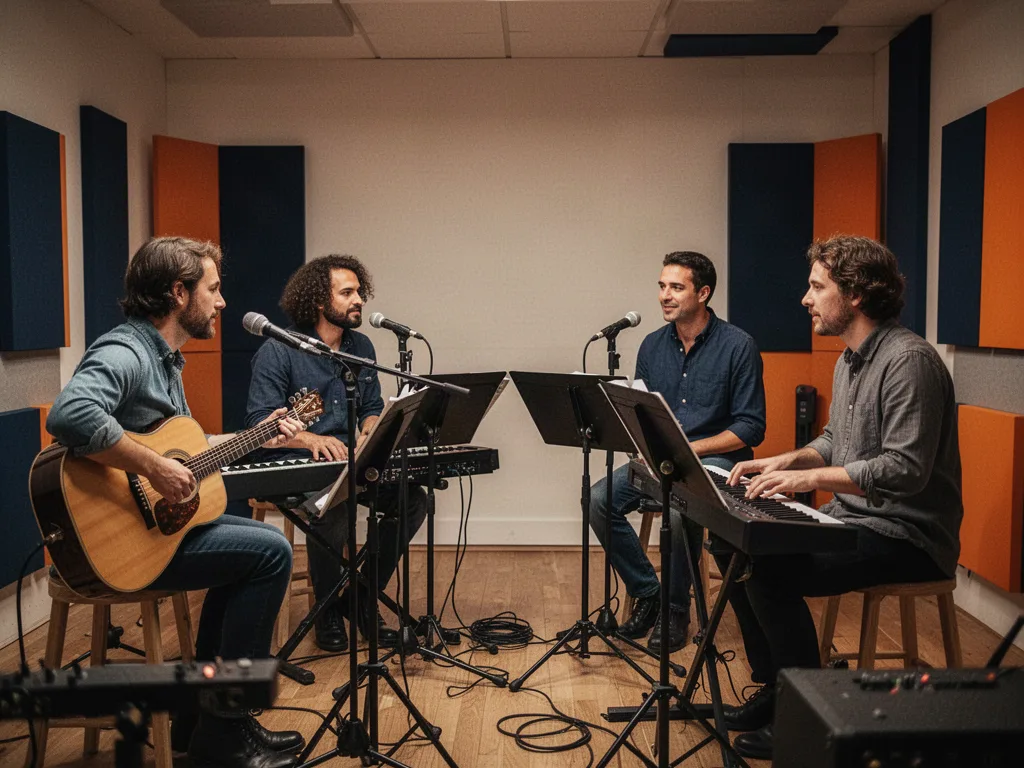
Make Music That Leaves Room for People: Arrangement as an Act of Listening
Great arrangements are not built by filling every frequency and every second. They create contrast, space, support, and a clear place for the most important voice to live.
Built for Songwriters, producers, worship teams, and musicians.
Musicians love adding things because adding feels productive. Another guitar. Another pad. Another harmony. Another fill. Another texture. But an arrangement becomes powerful when every part understands its role—including the role of silence.
Decide what the listener should follow
At any moment, something should usually be the emotional foreground: a lyric, melody, riff, groove, or instrumental voice. Supporting parts should help that focal point become clearer, not compete for the same attention. Arrangement is partly the art of saying “not now.”
Contrast creates shape
If every section is full, none of them feels full. Remove before you add. Let verse one be smaller than verse two. Hold a harmony until the lyric earns it. Drop an instrument before a chorus so the return feels larger. Space is one of the cheapest and most powerful production tools available.
Put it into practice
Identify the emotional foreground in each section.
Mute one part and listen for what becomes clearer.
Give instruments distinct rhythmic or frequency roles where possible.
Create at least one meaningful contrast between sections.
Use silence, stops, and held notes as arrangement choices.
Review the song at low volume; crowded arrangements often reveal themselves quickly there.
Carry this with you
A generous arrangement does not ask every musician to prove they belong. It gives each part the right moment to matter.
Questions people ask
How do I know if a song arrangement is too busy?
If the lyric or main musical idea becomes hard to follow, multiple parts compete in the same register or rhythm, or every section has the same density, the arrangement may need subtraction.
What is the easiest way to improve an arrangement?
Mute parts and listen. Removing one competing element often clarifies the focal point faster than adding another effect.
Do something with what you just read.
The best insight is the one that changes a conversation, a decision, a habit, a project, or the way you show up for another person.