top of page
< Back

Harmony in Milan: The 2026 Winter Olympics Begin

The Facts The 2026 Winter Olympics officially opened on February 6, 2026, with a ceremony at Milan's San Siro Stadium centered on the theme "Armonia" (Harmony). The Games: co-hosted by Milan and Cortina d'Ampezzo: mark the first Winter Olympics officially shared between two cities. Ninety-two nations participated in the opening ceremony, a three-hour production featuring international performers and a showcase of Italian culture. Preliminary competitions in curling, ice hockey, and freestyle...
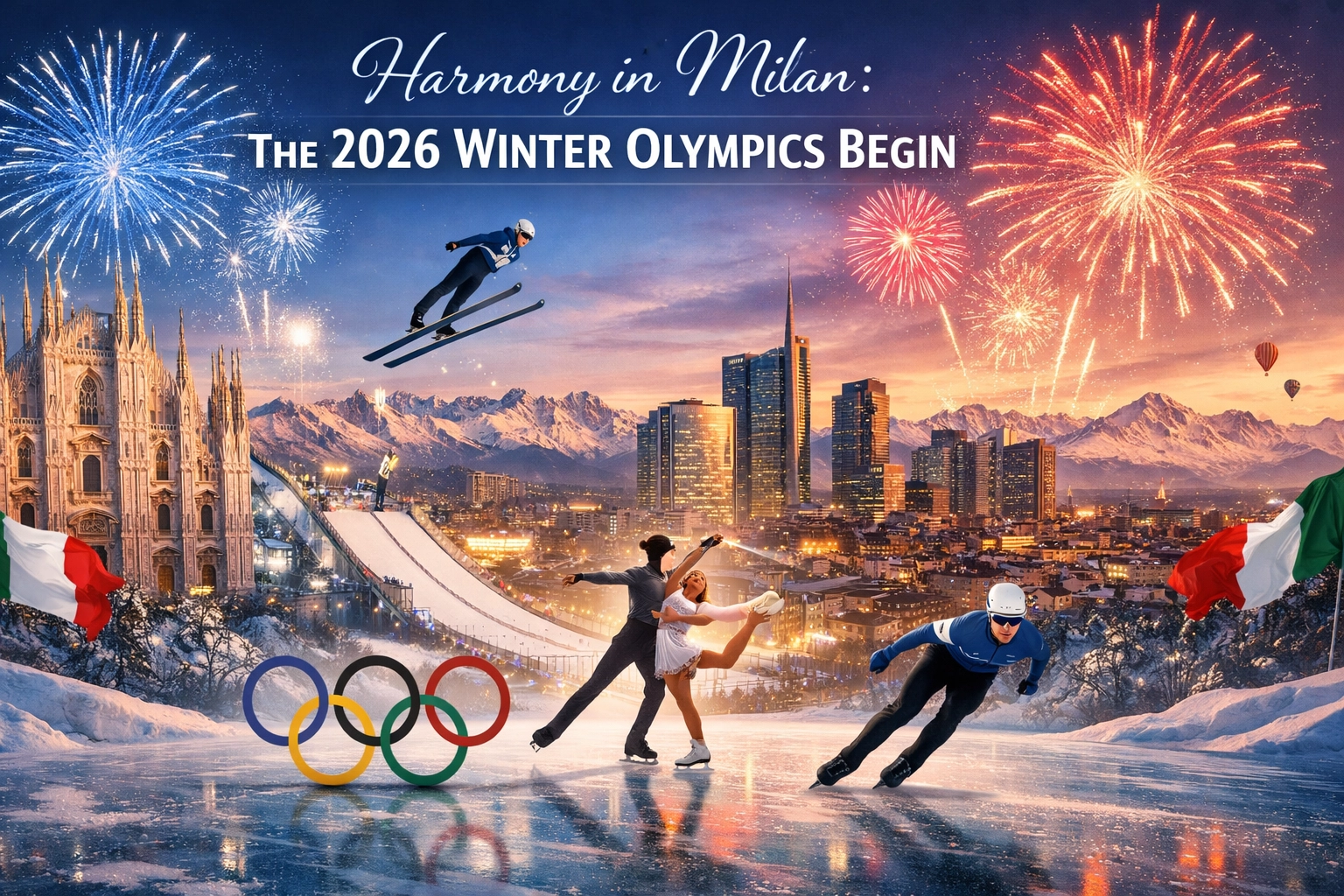
The Facts  The 2026 Winter Olympics officially opened on February 6, 2026, with a ceremony at Milan's San Siro Stadium centered on the theme "Armonia" (Harmony). The Games: co-hosted by Milan and Cortina d'Ampezzo: mark the first Winter Olympics officially shared between two cities. Ninety-two nations participated in the opening ceremony, a three-hour production featuring international performers and a showcase of Italian culture. Preliminary competitions in curling, ice hockey, and freestyle skiing began on February 4, two days before the official opening. The Games will feature 16 disciplines with 195 medals to be awarded through the closing ceremony on February 22. This year debuts ski mountaineering as a new Winter Olympic event. Milan primarily hosts ice events, while Cortina d'Ampezzo and clusters in the Valtellina and Fiemme valleys host skiing and sliding competitions across approximately 8,000 square miles of northern Italy. These are the first Olympic Games under IOC President Kirsty Coventry's leadership.  How it Happened  The "Harmony" theme emerged from Creative Lead Marco Balich's vision of bringing together diverse elements: a concept rooted in Ancient Greek philosophy that translates musically as different notes creating something beautiful together. Balich Wonder Studio produced the ceremony, which extended beyond San Siro Stadium to include athlete parades in Predazzo, Livigno, and Cortina d'Ampezzo. Italy won its bid to host the 2026 Games in June 2019, beating out Stockholm-Åre in the final vote. The dual-city model addressed concerns about cost and sustainability that have plagued recent Olympic bids. Rather than building new facilities, Milano Cortina 2026 organizers leveraged existing venues across northern Italy, spreading the economic impact and reducing construction waste. The geographic spread: the most expansive in Winter Olympics history: reflects both Italy's alpine geography and a new Olympic philosophy emphasizing practicality over spectacle. Milan brings metropolitan infrastructure and world-class ice facilities, while Cortina d'Ampezzo offers legendary mountain venues dating back to the 1956 Winter Games. Global icons like Mariah Carey headlined the opening ceremony, blending international star power with Italian cultural performances. The production balanced tradition and innovation, showcasing Italy's artistic heritage while signaling a forward-looking Games focused on unity.  Where We Are Now  Athletes from 92 nations have begun competing across northern Italy's winter sports venues. The geographically dispersed format means Olympic events are happening simultaneously in mountain villages, alpine valleys, and Milan's urban ice arenas: a logistical challenge that organizers say reinforces the "Harmony" message of coordinating diverse elements into a cohesive whole. Early competitions have drawn strong crowds despite concerns about whether the dual-city model would dilute fan energy. Local enthusiasm in both Milan and Cortina d'Ampezzo has exceeded expectations, with mountain communities embracing their role as Olympic co-hosts. The debut of ski mountaineering: a grueling endurance sport combining uphill skiing and alpine racing: has captured particular attention. The new discipline reflects the Olympics' ongoing evolution to include younger, adventure-focused competitions. Broadcasters report higher-than-anticipated global viewership for opening weekend events, suggesting the "Harmony" theme and Italy's cultural appeal are resonating beyond traditional winter sports markets. Social media engagement has spiked around both athletic performances and the scenic Italian backdrops. Security remains heightened across all venues, with Italian authorities coordinating protection for thousands of athletes, officials, and spectators spread across multiple regions. No significant incidents have been reported through the first three days of competition.  The Conversation  Supporters of the "Harmony" theme view it as a timely response to a fractured global moment. With ongoing conflicts in Eastern Europe, the Middle East, and other regions, the Olympics offer a rare platform where nations in tension send athletes to compete peacefully. Proponents argue that even symbolic gestures toward unity matter: that watching diverse nations celebrate shared excellence plants seeds of possibility for broader reconciliation. "Sport can't solve geopolitics, but it reminds us we're more alike than different," one commentator noted. The opening ceremony's emphasis on collaboration and beauty serves as a counterweight to division, they argue, giving the world permission to imagine peace even when peace seems distant. Critics question whether Olympic messaging can meaningfully address the world's deep fractures. Some see "Harmony" as a well-intentioned but ultimately hollow slogan: aspirational rhetoric disconnected from the hard work required to bridge ideological, economic, and political divides. They point out that nations at war still compete against each other, and that shared sports don't automatically translate into shared values or mutual understanding. Others note that previous Olympic unity themes have had minimal lasting impact on international relations. The symbolism feels good in the moment, they say, but fades quickly once athletes go home and geopolitical realities reassert themselves. Questions about China's participation, Russia's status, and various boycott discussions underscore how politics inevitably shadow even the most harmony-focused Games. A middle perspective acknowledges both the limits and the value of Olympic ideals: no sporting event will end wars, but deliberately creating spaces where people see each other as human competitors rather than faceless enemies has cultural significance that's hard to measure and easy to dismiss.  The Biblical Center  I'm Dr. Layne McDonald, and watching 92 nations gather under the banner of "Harmony" stirs something deep in me: something I believe God planted in every human heart. Psalm 133:1 comes immediately to mind: "How good and pleasant it is when God's people live together in unity!" The psalmist recognized what we instinctively know but often forget: we were designed for harmony, not isolation. We were created for connection, not constant conflict. The Olympics can't save the world. No sporting event can bridge the chasms of sin, pride, and broken relationships that separate people and nations. But these Games reflect a God-given longing that points beyond itself: the deep human desire for peace that only Christ can fully satisfy. Every time I see athletes from adversarial nations compete with respect, every time I watch fans from different backgrounds cheer for excellence regardless of nationality, I see glimpses of what the prophet Isaiah envisioned: nations streaming together, swords beaten into plowshares, the knowledge of the Lord covering the earth like waters cover the sea. We're image-bearers of the Creator. That means when we pursue harmony: even imperfectly, even temporarily: we're reflecting something true about God's nature and His design for humanity. The unity theme isn't naive idealism; it's an echo of Eden and a preview of the restored creation Jesus promised. I pray these Games remind us that our common humanity matters more than our competing interests. I pray they soften hearts hardened by political tribalism. And I pray they point people toward the One who said, "Blessed are the peacemakers, for they will be called children of God" (Matthew 5:9). The world doesn't need more Olympic slogans. It needs the Prince of Peace. But sometimes: just sometimes: a moment of beauty and shared celebration cracks open a heart just enough to let light in.  Finding Peace  The "Harmony" message doesn't have to stay in Milan. You can practice it in your sphere today. Start small and local.  Instead of engaging in an online argument this week, reach out to someone you genuinely disagree with. Not to debate them, not to change their mind: just to find one thing you both value. Maybe it's love for family. Maybe it's concern for your community. Maybe it's a shared memory or a common hope. Build on that single point of agreement. Let the light of Christ show through your kindness.  Jesus didn't call us to win arguments; He called us to love people. When you extend grace to someone across a divide, you're creating a small pocket of harmony that reflects God's kingdom. That matters infinitely more than scoring rhetorical points. Pray for those you view as opponents.  This might be the hardest instruction, but it's also the most powerful. When you sincerely pray for someone's wellbeing: even someone whose politics or theology you find troubling: you're inviting God to soften both their heart and yours. Harmony begins when we see others as people loved by God, not merely obstacles to overcome. Model unity in your family and faith community.  If the Olympics can bring 92 nations together for seventeen days, surely the body of Christ can demonstrate unity despite denominational differences, stylistic preferences, and secondary doctrinal disputes. Where are you contributing to division when you could be pursuing peace? The world is watching how Christians respond to conflict, criticism, and cultural tension. Let them see something different in you: not compromise on truth, but a commitment to love even when love costs you something. Harmony isn't about pretending disagreements don't exist. It's about refusing to let those disagreements destroy our shared humanity. It's about choosing connection over contempt, even when contempt feels justified. The Olympics will end on February 22. But the call to be peacemakers never expires. Start today. Your sphere of influence might not be global, but it's the one God gave you: and it's exactly where He wants you to bring His light. Source:  Official Milano Cortina 2026 organizing committee announcements, NBC Olympics coverage, IOC press releases Sonny-Ready Caption Block: 
 The world is watching Milan! ❄️ With a theme of "Harmony," the 2026 Winter Olympics are underway. Dr. Layne McDonald looks at why this message of unity matters more now than ever. Stay grounded: www.laynemcdonald.com  #MilanCortina2026 #WinterOlympics #Harmony #JesusCenteredNews

harmony-in-milan-the-2026-winter-olympics-begin

Dr. Layne McDonald
Creative Pastor • Filmmaker • Musician • Author
Memphis, TN

  • Apple Music
  • Spotify
  • YouTube
  • TikTok
  • Instagram
  • Facebook
  • LinkedIn
  • X

Sign up for our newsletter

© 2025 Layne McDonald. All Rights Reserved.

bottom of page