
Music: My Sunday Setlist Checklist (A Worship Leader's Guide to Pastoral Song Choices)
- Dr. Layne McDonald
- Feb 8
- 4 min read

Every Saturday night, I sit with my guitar, a half-empty coffee cup, and a blank setlist template. And every week, I ask myself the same question: Am I choosing these songs because they're easy, or because they're exactly what my congregation needs?
If you lead worship: whether in a mega-church sanctuary or a living room Bible study: you know the weight of that question. The songs we choose on Sunday morning aren't just background music. They're prayers. They're theology. They're the soundtrack to someone's encounter with God.
After years of trial, error, and a few cringe-worthy setlist disasters, I've developed a checklist that keeps me honest, prayerful, and intentional. Here's what I walk through every single week.
Start With Prayer, Not Spotify
I'll be honest: my default mode used to be scrolling through the latest CCLI chart and grabbing whatever sounded current. But I've learned the hard way that popularity doesn't equal pastoral appropriateness.
Before I open Spotify, Planning Center, or my hymnal, I pray through these questions:
What is my congregation walking through right now? (Grief? Joy? Uncertainty? Revival?)
What spiritual truths do they need to hear sung over them this week?
What is the Holy Spirit highlighting to me in my own walk?
I also make it a point to connect with pastoral leadership. Sometimes the senior pastor has insight into upcoming sermon themes or knows that half the church is processing a community tragedy. When worship and teaching align, the entire service becomes a cohesive spiritual journey instead of disconnected segments.
Organize Your Master List by Function
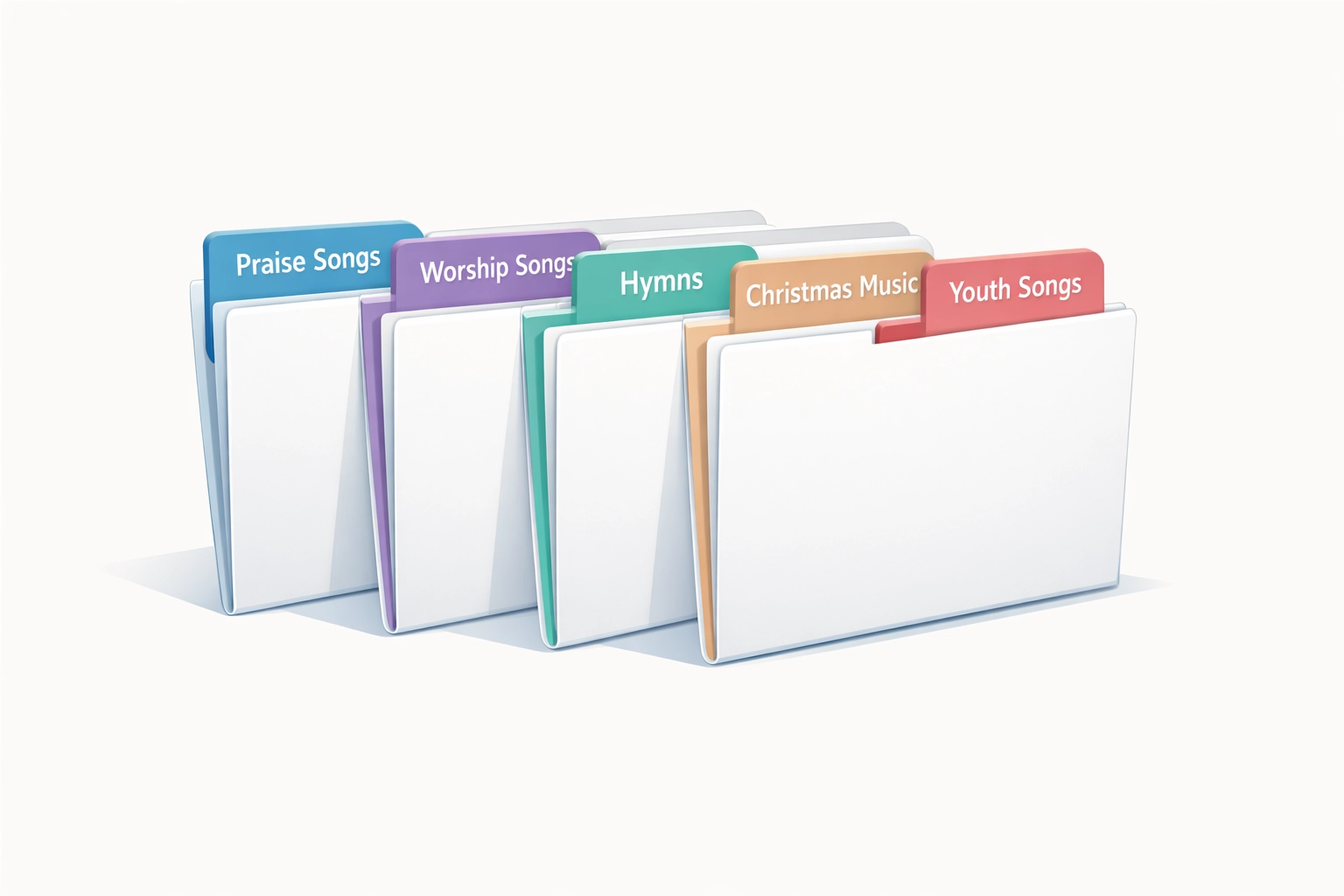
One of the best shifts I made was categorizing my song library by function instead of just artist or era. I keep folders (digital or physical) labeled:
Call to Worship – Songs that gather people's attention and hearts toward God
Confession/Lament – Songs that create space for honesty and repentance
Praise – High-energy declarations of who God is
Adoration – Intimate, slower songs of love and wonder
Communion/Reflection – Meditative pieces
Response – Songs that invite personal commitment
Sending – Songs that commission people back into the world
When I build a setlist, I don't just pick five songs I like. I think: What does this moment in the service need? If we're opening, I need a song that invites. If we're closing after a sermon on mission, I need a song that sends.
Follow a Lyrical Progression
This one changed everything for me. I used to think about setlists in terms of tempo: fast, fast, slow, slow. But I've learned to think in terms of lyrical movement:
The goal is to take people on a journey from entering to encountering.
Balance the "I, We, God" Perspective
I keep a mental tally of whose voice dominates my setlist. Are most songs sung from an individual "I" perspective? A corporate "We"? Or are they directed toward God in second person ("You")?
A healthy setlist usually includes all three, but I've noticed that ending with "You" songs creates the most powerful moments of intimacy. When the final song is sung to God rather than about God, it places people in direct conversation with Him.
For example:
"I" song: How Great Thou Art ("Then sings my soul...")
"We" song: Build Your Kingdom Here ("Come set Your rule and reign...")
"You" song: O Come to the Altar ("You are faithful, God, You are faithful...")
Include One New, Keep the Familiar
I try to introduce one new song per week: not more. If I throw three unfamiliar songs into a setlist, I lose the congregation. They spend the whole time reading lyrics instead of worshiping.
But if I never introduce anything new, we stagnate. We become a church that only sings songs from 2012.
So I pair the new with the familiar. I sandwich the new song between two classics. I also try to repeat new songs within a 4–6 week cycle so people have multiple exposures before it becomes part of the regular rotation.

Plan in Blocks, Not Weeks
Instead of planning one week at a time, I map out 6–8 weeks at a stretch. This helps me avoid accidental patterns (like always opening with upbeat songs or closing with the same hymn three weeks in a row).
I also build setlists around themes or seasons:
Advent/Christmas
Lent/Easter
Back-to-school (for churches with lots of families)
Missions emphasis months
Planning in blocks gives me margin to adjust when the Holy Spirit redirects, but it keeps me from scrambling every Saturday night.
Mind the Keys and Transitions
I used to pick songs I loved and then panic when I realized they didn't flow together. One was in E, the next in B♭, and the tempo drop was jarring.
Now I think about musical connective tissue:
Can I modulate smoothly between keys?
Does the tempo shift feel natural, or does it kill momentum?
Are we asking the band to retune mid-set?
Sometimes the "perfect" song doesn't work because it disrupts the flow. And that's okay. Worship is more than a playlist: it's a progression.
Takeaway / Next Step
Here's my challenge for you this week: Don't build your next setlist on autopilot.
Before you click on the trending worship chart, sit with your congregation in your mind. Picture their faces. Think about what they're walking through. Pray over the songs you're considering. Ask the Holy Spirit to guide you toward the melodies and lyrics that will meet your people exactly where they are.
And if you're not a worship leader but you attend a church, take a moment this Sunday to thank the person who builds the setlist. Pray for them. They're carrying a pastoral weight you might not see.
Worship leading isn't about performance. It's about partnership: partnership with the Holy Spirit, partnership with pastoral leadership, and partnership with a congregation hungry to encounter God.
If this resonated with you, I'd love to hear your own setlist strategies or worship leadership questions: reach out to me on the site. Browsing and visiting the site helps raise funds for families who lost children at no cost to you, simply through ad revenue supporting a meaningful cause. And if you're looking for deeper biblical teaching and a community to grow with, check out Boundless Online Church: you can explore privately or sign up to dive in. I'd also love it if you shared this post with another worship leader who might need the encouragement today.
Comments