
Repair Culture: How to Disagree, Confess, Apologize, and Rebuild Trust Like Christians
- Dr. Layne McDonald
- Dec 30, 2025
- 5 min read

Updated: Jan 4
The silence was deafening. What started as a disagreement over worship style had escalated into a full church split. Families stopped speaking. Friendships died. The pastor resigned. And everyone wondered how a community built on love could fracture so completely over something so small.
Sound familiar? You're not alone.
Churches across America are hemorrhaging relationships because we've mastered the art of singing together but never learned the skill of staying together when things get messy. We can quote verses about forgiveness all day long, but when someone actually hurts us? We either explode or disappear. Neither response builds the Kingdom.
Here's the hard truth: conflict avoidance is not peace, and pretending everything is fine is not Christian maturity. Real peace requires the courage to engage, the humility to own our part, and the wisdom to rebuild what's been broken.
Why Conflict Avoidance Kills Community
Many Christians believe that avoiding conflict is spiritual. We think keeping quiet when we're hurt is "turning the other cheek." We convince ourselves that letting things slide is "being gracious."
But here's what actually happens when we avoid necessary conversations:
Resentment grows in silence. That hurt you never addressed? It's not gone. It's growing roots, spreading poison through your heart and eventually leaking out in passive-aggressive comments, cold shoulders, and whispered complaints to others.
Problems multiply. Small issues that could be resolved with a honest conversation become massive relationship fractures when left untreated. What started as a misunderstanding becomes a character assassination in our minds.
The community suffers. When two people refuse to address their conflict, it creates awkward tension that affects everyone around them. Team meetings become minefields. Fellowship events feel forced. The whole church walks on eggshells.
Jesus didn't model conflict avoidance. He confronted the Pharisees directly. He called out Peter's hypocrisy. He overturned tables when necessary. But He did it all in love, with the goal of restoration, not destruction.
Matthew 5:23-24 gives us a clear directive: "If you are offering your gift at the altar and there remember that your brother or sister has something against you, leave your gift there in front of the altar. First go and be reconciled to them; then come and offer your gift."
Notice what Jesus doesn't say. He doesn't say "pray about it and hope it goes away." He doesn't say "just forgive them in your heart and move on." He says go. Have the conversation. Do the work of reconciliation.

The Anatomy of a Real Apology
Not all apologies are created equal. We've all heard the non-apologies: "I'm sorry you feel that way." "I'm sorry if I hurt you." "I'm sorry, but you did..."
These aren't apologies: they're deflections with spiritual wrapping paper.
A real, biblical apology contains five essential elements:
1. Acknowledgment of the specific wrong "I spoke harshly to you in front of the team" is better than "I'm sorry for whatever I did."
2. Acceptance of responsibility "I was wrong" without explanation, justification, or blame-shifting.
3. Authentic remorse "I understand that my words hurt you, and I feel terrible about that."
4. Request for forgiveness "Will you forgive me?" This creates space for the other person to respond genuinely.
5. Commitment to change
"I'm going to work on managing my stress better so this doesn't happen again."
What a real apology doesn't include:
Justification for your behavior
Minimizing the impact ("it wasn't that bad")
Demanding immediate forgiveness
Making it about your guilt instead of their pain
Remember: the goal of an apology isn't to make you feel better: it's to begin healing the relationship.
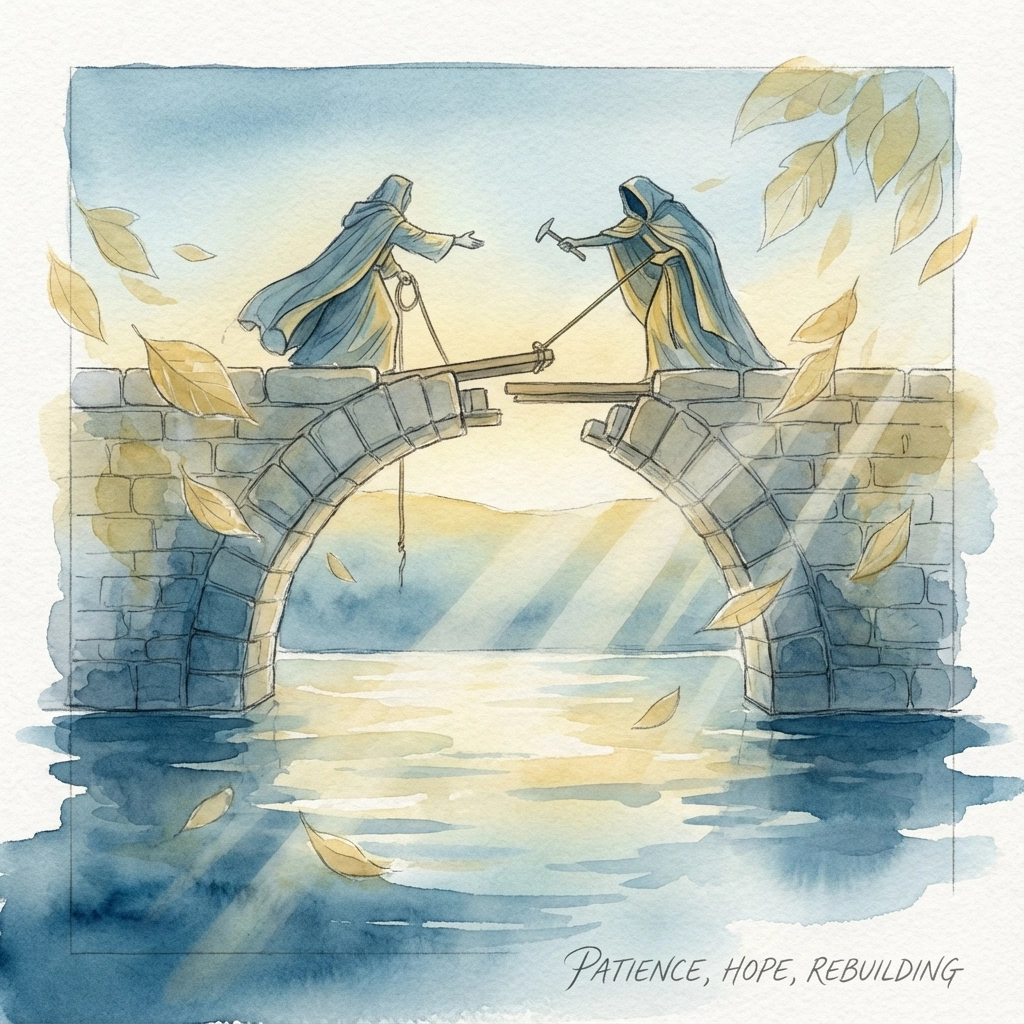
Rebuilding Trust Takes Time (And That's Okay)
Here's where many Christians get frustrated. We apologize sincerely, the other person says
"I forgive you," and we expect everything to go back to normal immediately. When it doesn't, we get offended.
But forgiveness and trust are two different things.
Forgiveness is a gift: it can be given instantly, chosen as an act of will, offered regardless of whether it's deserved.
Trust is an investment: it must be earned over time through consistent, trustworthy behavior.
Colossians 3:13 reminds us to "bear with each other and forgive one another if any of you has a grievance against someone. Forgive as the Lord forgave you." But even God's forgiveness doesn't immediately restore all privileges. There are still consequences. There's still a process of growth and rebuilding.
When someone has been hurt deeply, they need time to see that your apology was backed up by changed behavior. This isn't punishment: it's wisdom. And rushing them through their healing process often causes more damage.
Practical steps for rebuilding trust:
Be patient with their process. Healing happens at their pace, not yours.
Demonstrate change consistently. Don't just promise to do better: actually do better, repeatedly.
Check in without pressuring. "How are we doing?" is better than "Aren't we good now?"
Respect new boundaries. They may need different parameters in the relationship, and that's okay.
Stay committed to the long game. Trust rebuilds in small moments over extended time.
A Simple Repair Script for Your Church
Every church needs a shared language for handling conflict. Here's a simple framework you can teach and practice in small groups:
The HEARTS Method:
H - Halt. Stop the escalation. "Can we pause and restart this conversation?"
E - Examine. Look at your own contribution first. "What part of this conflict do I own?"
A - Approach. Go directly to the person, not to everyone else. "I'd like to talk with you about what happened."
R - Repair. Use the five-part apology when you've done wrong. Own your part fully.
T - Time. Allow space for healing and trust rebuilding. Don't rush the process.
S - Seek help. When you're stuck, bring in wise counsel or mediation.
Practice this script in your small groups. Role-play common scenarios. Make repair a normal part of your church culture, not a crisis intervention.
Romans 12:18 gives us the right perspective: "If it is possible, as far as it depends on you, live at peace with everyone." Notice it says "as far as it depends on you." You can't control their response, but you can control your approach.
Building a Church That Knows How to Fight and Stay Together
Healthy churches aren't conflict-free churches: they're churches that know how to navigate conflict with grace and wisdom. They're communities where:
Difficult conversations are normal, not nuclear
Leaders model healthy conflict resolution
Apologies are specific, not generic
Forgiveness is expected, but trust rebuilding is respected
People receive training in relational skills, not just biblical knowledge
This kind of culture doesn't happen by accident. It requires intentional leadership, regular teaching, and lots of practice in safe environments.
Start small. Train your small group leaders first. Give them tools and language. Let them practice with each other before teaching others. Make repair a ministry, not just damage control.
Your Next Step
This series has explored 22 real human issues that fracture churches and break relationships. From gossip disguised as prayer requests to the trauma of spiritual manipulation, we've named the dark places where Christians hurt each other and pointed toward biblical solutions.
But reading about repair isn't the same as learning to repair. Knowing these principles intellectually won't transform your relationships automatically. You need practice, support, and sometimes professional guidance to break old patterns and build new skills.
If any of these topics has stirred something in you: whether conviction, hope, or just the recognition that you need help: you don't have to figure it out alone.
Whether you're a pastor trying to lead a healthier church, a member struggling with relationships, or someone who's been hurt by the church and needs healing, support is available.
Visit laynemcdonald.com to explore resources, coaching, and community designed to help you grow in wisdom, build stronger relationships, and become the kind of person others can trust and follow.
The church Jesus envisioned is possible. It's a community where people can disagree without destroying each other, where apologies are real and forgiveness flows freely, where trust is rebuilt through patient love and consistent action.
That church starts with you choosing to learn repair instead of just singing about redemption.
Comments