The Celestial Parade: Finding Peace Under the Stars Tonight
- Dr. Layne McDonald
- Feb 28
- 5 min read

Updated: 11 hours ago
If you step outside tonight and look up, you aren't just looking at the night sky.
You are looking at a rare cosmic alignment.
On this Saturday, February 28, 2026, six planets in our solar system: Mercury, Venus, Saturn, Jupiter, Uranus, and Neptune: are performing what astronomers call a "planetary parade."
In a world that often feels loud, fractured, and hurried, the sky offers us something different tonight.
It offers order.
It offers scale.
Most importantly, it offers a moment of profound peace.
Whether you are a backyard astronomer with a high-powered telescope or someone just stepping onto your porch to catch a breath of fresh air, tonight is a gift.
The Facts: What Is Happening Tonight?
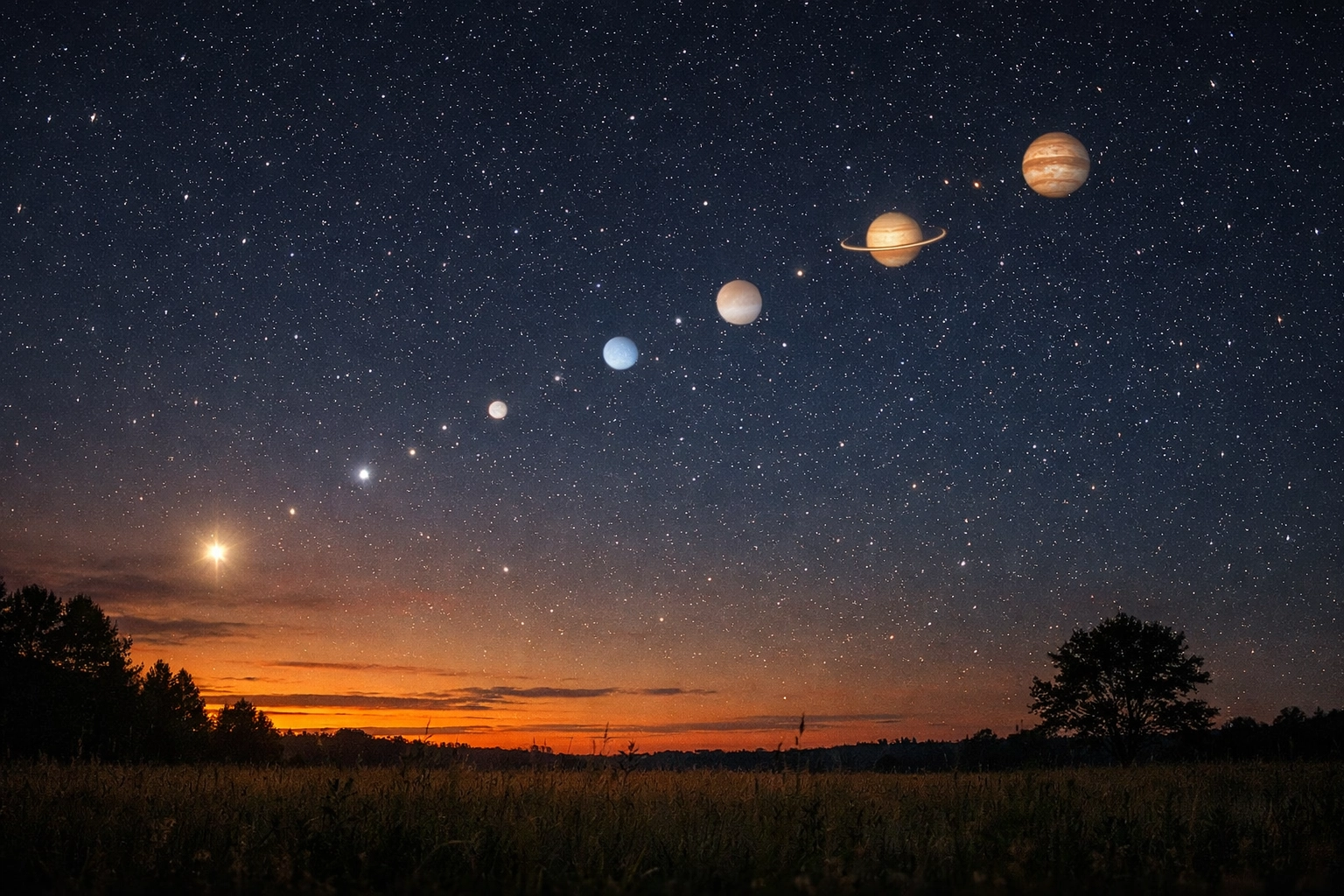
A planetary alignment occurs when several planets gather on one side of the Sun at the same time.
From our perspective on Earth, they appear to line up in a relatively straight path across the sky.
Tonight’s "parade" features six of our neighbors.
However, seeing all of them requires a bit of planning and the right tools.
Here is the breakdown of what is happening in the sky:
The Window: The best time to view this alignment is roughly 30 to 60 minutes after sunset.
In the Central Time Zone, that means looking up around 5:45 PM to 6:30 PM.
Jupiter and Venus will be the showstoppers.
Saturn and Mercury are visible but lower on the horizon.
Uranus and Neptune are far too faint for the human eye and will require binoculars or a telescope.
Viewing Guidance: Where to Look
To see the parade, you need a clear view of the horizon.
If you are surrounded by tall buildings or dense trees, you might miss the lower-hanging planets.
Look West: This is where the action starts.
As the sun dips below the horizon, Venus will be the first to pop out.
It is the brightest object in the sky other than the Moon.
Close to it, you will find Mercury and Saturn.
Because they are so low, they will disappear quickly as they follow the sun down.
Look Up and Southeast: Jupiter will be much easier to find.
It’s a brilliant, steady light nearly straight overhead.
Unlike stars, planets don’t twinkle; they glow with a constant, firm light.
The Faint Neighbors: If you have binoculars, scan the area between the visible planets to find Uranus and Neptune.
They will look like tiny, bluish dots, barely distinguishable from stars without a steady hand and a bit of patience.
Context: The Rarity of the Alignment
We often think of the solar system as a static map in a textbook, but it is a complex, moving dance.
Each planet orbits at a different speed and a different distance.
Mercury zips around the sun in just 88 days.
Neptune takes 165 years to complete a single trip.
For six of these celestial bodies to line up in the same narrow slice of our sky is a mathematical rarity.
While "planetary parades" happen every few years, the specific combination and visibility of these six planets make tonight special.
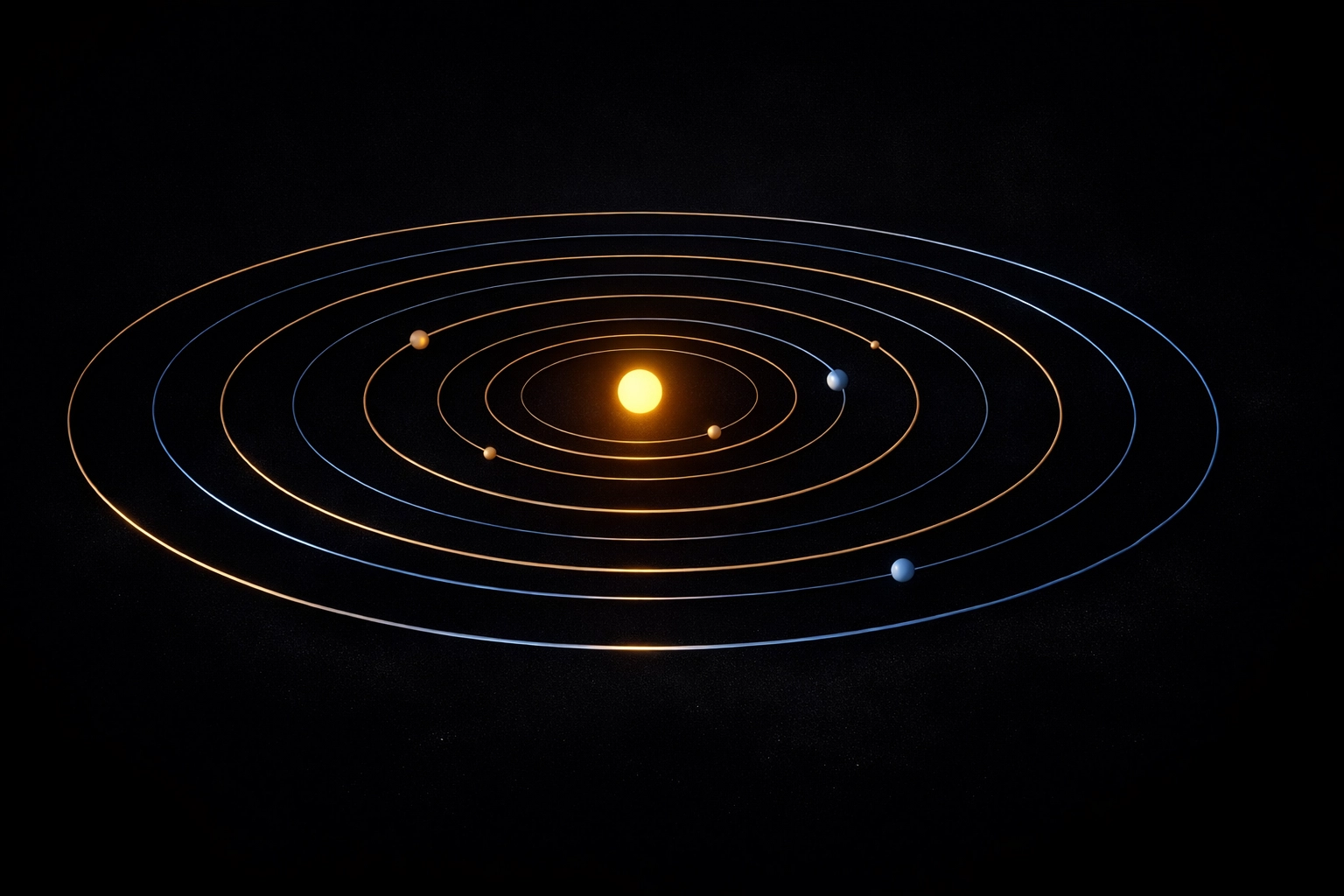
This alignment isn't a physical "straight line" in space.
If you were looking down on the solar system from above, the planets would still be scattered across their various orbits.
The "parade" is a matter of perspective: it is how they appear to us, standing on this spinning blue marble, looking out into the deep.
Two Viewpoints: Scientific Curiosity and Spiritual Awe
When we look at an event like this, we usually approach it from one of two angles.
The first is scientific curiosity.
We want to know the "how."
We study the gravitational pulls, the orbital resonances, and the atmospheric compositions of these distant worlds.
We marvel at the fact that we can predict these movements down to the second, centuries in advance.
Science reminds us that we live in a predictable, governed universe.
The second is spiritual awe.
This is the feeling that washes over you when you realize how small you are and how vast the creation is.
It’s the "why."
Why is there beauty in the alignment?
Why does a quiet, starry night have the power to calm a racing heart?
At The McReport, we believe these two viewpoints aren't in conflict.
In fact, they complete each other.
The more we understand the complexity of the "how," the more we can appreciate the majesty of the "Who" behind it.
The Biblical Lens: The Heavens Declare
As an organization rooted in the faith of the Assemblies of God, we look at the stars and see more than just gas, rock, and gravity.
We see the handiwork of a Creator.
Psalm 19:1 says, "The heavens declare the glory of God; the skies proclaim the work of his hands."
Think about that for a moment.
The planets aren't just floating there by accident.
They are "proclaiming."
They are telling a story of power, order, and intentionality.
Tonight’s alignment is like a sentence written across the cosmos, reminding us that there is a Designer who set the stars in their places and knows them each by name.
In the AG tradition, we lean heavily into the majesty of God’s creation.
We believe in a God who is big enough to move Jupiter but kind enough to hear a whispered prayer.
When we see the "Celestial Parade," we see a reflection of the Divine Order.
If God can keep six planets in perfect synchronization across millions of miles of vacuum, we can trust Him with the details of our lives.
The vastness of the solar system should not make us feel insignificant.
Instead, it should make us feel deeply loved.
The same God who breathed the stars into existence is the same God who offers us salvation, healing, and hope.

Finding Peace in the Perspective
It is easy to get bogged down in the "earthly" news.
We deal with inflation, political tension, family struggles, and personal anxieties.
These things are real, and they are heavy.
But tonight, the sky offers a perspective shift.
When you look at Saturn, which is nearly 900 million miles away, your problems don't necessarily disappear, but they find their proper place.
You are part of a story that is much bigger than your current "to-do" list.
There is a unique peace that comes from "looking up."
It forces your shoulders to drop.
It forces your breath to slow down.
It reminds you that the world is not resting on your shoulders: it is resting in the hands of the One who made the stars.
Your Next Step: Step Outside
Our invitation to you tonight is simple: Take a moment.
Life moves fast.
We spend most of our time looking at screens that are six inches from our faces.
Tonight, look at something that is millions of miles away.
Spend five minutes just being present under the sky.
If you have children or grandchildren, bring them with you.
Point out the bright glow of Venus.
Show them Jupiter hanging high in the sky.
Tell them that the same God who keeps those planets moving is watching over them, too.
A Hopeful Closing
We live in a beautiful, complex, and intentional world.
Tonight’s planetary parade is a reminder that even in times of uncertainty, there is a rhythm to creation that remains unbroken.
There is a glory that outshines our deepest fears.
As you look at the stars tonight, may you feel the presence of the Creator.
May you find the peace that surpasses understanding.
And may you remember that you are never walking this journey alone.
Need prayers? Text us day or night at 1-901-213-7341.
Follow for more Christ-centered clarity on today’s biggest questions at LayneMcDonald.com.
Source: BBC News, NASA, Star Walk

Comments