Brief: FAA tightens helicopter rules near Reagan National after deadly midair collision
- Dr. Layne McDonald
- Feb 5
- 5 min read

Quick Summary
What changed: The FAA permanently restricted helicopter and powered-lift operations near Reagan National Airport after a January 2025 midair collision killed 67 people.
Why it matters: New rules prioritize lifesaving missions over routine training flights in critical airspace.
Biblical lens: Psalm 90:12 calls us to number our days wisely: stewardship of life includes safety reforms.
Our response: Pray for grieving families and support efforts that protect travelers and pilots alike.
What Happened: A Tragedy Leads to Permanent Airspace Changes
On a January evening in 2025, a U.S. Army Black Hawk helicopter and an American Airlines regional jet collided midair near Ronald Reagan Washington National Airport.
All 67 souls aboard both aircraft perished. Recovery teams have now identified 66 of the 67 victims, and all remains have been retrieved from the Potomac River. The National Transportation Safety Board continues its investigation into the accident, which has already reshaped federal aviation policy.
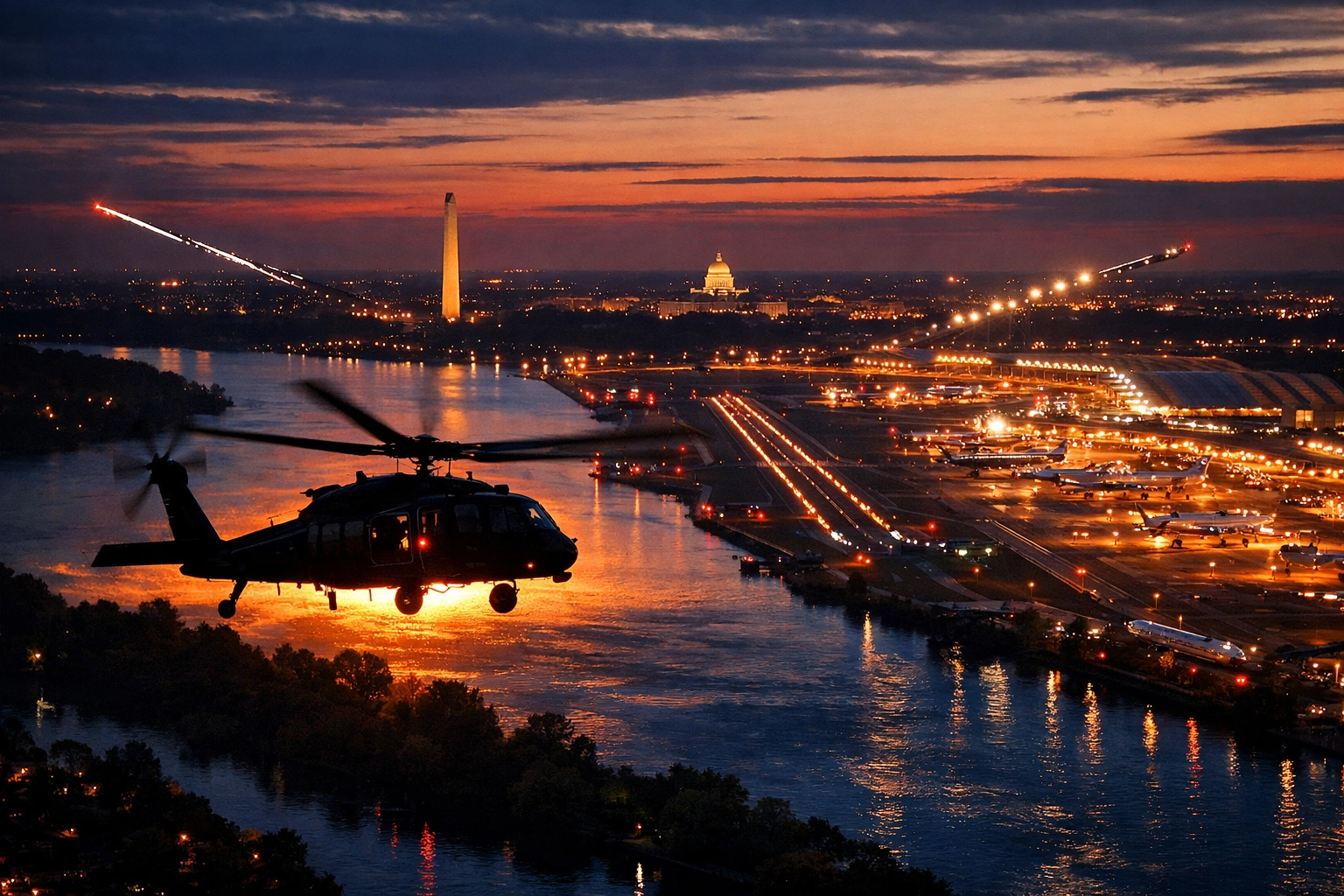
In response, the Federal Aviation Administration published an interim final rule on January 23, 2026, permanently restricting helicopter and powered-lift aircraft operations in a designated area over the Potomac River: from the surface to 1,500 feet mean sea level. The rule formalizes emergency measures put in place immediately after the crash and implements key recommendations from the NTSB.
What's banned: Helicopters and powered-lift aircraft operating in vertical-lift mode are now prohibited in this critical airspace unless conducting essential operations. The FAA defines essential operations as lifesaving medical flights, active law enforcement missions, national security work, continuity-of-government activities, and transport for the President or Vice President.
What's excluded: Proficiency evaluation flights, routine training operations, and personnel transportation not directly tied to essential missions are no longer permitted in the restricted zone. This change directly addresses concerns raised by investigators: the accident helicopter was conducting a military proficiency evaluation at the time of the collision, not an urgent operational mission.
The FAA also closed Helicopter Route 4, updated helicopter route charts at major regional airports, required military aircraft to transmit ADS-B signals in certain areas, and eliminated visual separation procedures within five nautical miles of Reagan National. These restrictions remain in effect through late February while the NTSB completes its investigation, though the interim final rule suggests many measures will become permanent.
Why It Matters: Stewardship of Life and Public Trust
Sixty-seven families are now navigating grief that no funeral or policy change can fully heal. But the FAA's swift action reflects a broader principle: when tragedy reveals a gap in safety protocols, those gaps must close quickly.
Aviation is one of the safest modes of travel in human history, but that safety is maintained through constant vigilance, clear protocols, and willingness to adapt. The airspace around Washington, D.C., is uniquely complex: balancing commercial traffic, military operations, law enforcement, and emergency medical flights in one of the nation's most restricted zones. The January collision exposed vulnerabilities in that system, particularly around non-essential training flights conducted in high-traffic areas.

Public confidence is at stake. Millions of Americans fly in and out of Reagan National every year. Military families depend on safe training protocols. Emergency medical teams need clear lanes for lifesaving flights. When regulators act decisively to close loopholes and tighten airspace rules, it sends a signal: your life matters, and we're willing to change systems to protect it.
Different perspectives exist. Some pilots and military leaders have raised concerns that overly restrictive airspace rules could limit training opportunities and operational flexibility. Others argue that proficiency flights can be conducted in less congested areas, reserving the most sensitive airspace for missions that can't wait. Both sides agree on one thing: the January collision should never happen again.
The interim final rule is open for public comment, meaning stakeholders: pilots, airlines, military leaders, and concerned citizens: can weigh in on whether these restrictions strike the right balance. That feedback loop is part of how aviation safety evolves: tragedy sparks action, but thoughtful review ensures the action is wise, not just reactive.
A Biblical Lens: Numbering Our Days
Psalm 90:12 (NIV):"Teach us to number our days, that we may gain a heart of wisdom."
This ancient prayer from Moses asks God for a specific kind of wisdom: the ability to live with an awareness of life's fragility and preciousness. To "number our days" doesn't mean to live in fear: it means to live with intentionality, gratitude, and stewardship.
Sixty-seven people boarded aircraft on January 29, 2025, expecting to reach their destinations. They numbered their days, made plans, said goodbyes, and trusted the systems designed to keep them safe. When those systems failed, their families were left with unbearable loss. But their deaths were not meaningless: if we respond with wisdom.

Stewardship of life includes safety reforms. Christians believe every human being bears the image of God (Genesis 1:27). That belief demands we take reasonable steps to protect life wherever possible. Aviation safety isn't just a technical issue: it's a moral one. When we know that tighter airspace rules, better communication protocols, or clearer mission priorities can prevent deaths, we have a responsibility to act.
Wisdom learns from tragedy. Proverbs 1:5 tells us, "Let the wise listen and add to their learning." The FAA's response: closing loopholes, restricting non-essential flights, and requiring better tracking technology: reflects a willingness to learn. It's not about assigning blame; it's about creating systems that honor the value of every life.
This is the posture Christians bring to moments like these: grief without despair, reform without rage, and a commitment to protecting the vulnerable without demonizing those who made mistakes.
A Christian Response: Pray, Support, Advocate
As followers of Jesus, we're called to respond to tragedy with compassion, wisdom, and action. Here's how we can do that in the wake of this collision and the FAA's new rules:
1. Pray for the families. Sixty-seven people are gone. Their loved ones are still processing shock, anger, and sorrow. Pray for comfort, for the strength to face another day, and for the peace that only God can provide. Pray also for the investigators, regulators, and pilots working to prevent future tragedies: they carry a heavy burden.
2. Support safety reforms. If you're a pilot, aviation professional, or military leader, engage with the FAA's public comment process. Offer your expertise. If you're a concerned citizen, advocate for policies that prioritize life over convenience. Safety reforms often require tradeoffs: longer flight times, restricted training areas, additional costs: but those tradeoffs are worth it if they save lives.
3. Trust the process, but stay informed. The NTSB's investigation will take months. Resist the urge to assign blame prematurely or spread speculation. Instead, follow credible sources, ask thoughtful questions, and hold regulators accountable for transparency and follow-through.
4. Live with awareness. Psalm 90:12 reminds us that numbering our days isn't morbid: it's wise. Tell the people you love that you love them. Make peace where peace is possible. Steward your time, your relationships, and your calling with the awareness that none of us is guaranteed tomorrow.
A Closing Prayer
Father, we bring before You the 67 lives lost in the January collision: each one precious, each one bearing Your image. Comfort their families in ways only You can. Give investigators wisdom as they search for answers. Guide the FAA and military leaders as they balance safety, training, and mission readiness. Help us number our days, that we may live with gratitude, purpose, and compassion. In Jesus' name, Amen.
Stay Grounded and Connected
Want more resources? Head to www.laynemcdonald.com for coaching, mentoring, blog posts, music, and more. Simply visiting the site helps raise funds for families who have lost children through Google AdSense: at no cost to you. Every click is a small act of giving back.
The McReport exists to deliver truth with compassion, conviction without contempt, and hope rooted in Scripture. We're here to help you stay informed, grounded, and anchored in Jesus( no matter what the headlines say.)

$50
Product Title
Product Details goes here with the simple product description and more information can be seen by clicking the see more button. Product Details goes here with the simple product description and more information can be seen by clicking the see more button

$50
Product Title
Product Details goes here with the simple product description and more information can be seen by clicking the see more button. Product Details goes here with the simple product description and more information can be seen by clicking the see more button.
$50
Product Title
Product Details goes here with the simple product description and more information can be seen by clicking the see more button. Product Details goes here with the simple product description and more information can be seen by clicking the see more button.
Comments