Morning Headlines Making You Anxious? Here's Your 5-Minute Reset Before the World Wakes Up
- Dr. Layne McDonald
- Feb 16
- 5 min read

You know the feeling. Eyes barely open, hand reaching for the phone on your nightstand, thumb scrolling through headlines before your feet even hit the floor. Within sixty seconds, your nervous system is flooded with breaking news, global crises, political drama, and tragedy you can't control.
Your heart rate climbs. Your shoulders tense. And you haven't even brushed your teeth yet.
If checking the morning news has become your wake-up alarm, you're not alone, but there's a better way to start your day. Before the world demands your attention, you can take back those first precious minutes and build emotional resilience that carries you through whatever the headlines throw at you.
The Facts: How Morning News Hijacks Your Day
The data is clear: our morning routines shape the entire trajectory of our day. When you reach for your phone first thing, you're handing control of your emotional state to algorithms designed to keep you scrolling, not to keep you centered.
Research shows that breathwork and grounding techniques can lower heart rate and cortisol levels, your body's stress hormones, within minutes. Deep breathing slows your breath rate and calms your nervous system, allowing you to approach information from a place of control rather than reactivity.

Morning anxiety often stems from immediately flooding your mind with everything you need to worry about, all at once. Headlines are designed to grab attention, which means they're often framed in the most alarming way possible. When you start your day in that state, you're essentially choosing anxiety as your baseline before you've even had a chance to remember who you are.
Grounding techniques, using sensory awareness to anchor yourself in the present moment, pull you out of future-focused worry and into the reality of right now. And setting intentional news boundaries, like designating a specific time slot to check headlines rather than scrolling round-the-clock, measurably reduces the constant pressure to stay updated.
Even just ten minutes of daily meditation or mindfulness practice shows measurable stress reduction over time. That means small, consistent changes actually work.
The Lens: What Scripture Says About Your Morning
Here's the thing: the Bible has a lot to say about how we start our day, and none of it involves checking our phones in a panic.
The Psalmist writes, "In the morning, LORD, you hear my voice; in the morning I lay my requests before you and wait expectantly" (Psalm 5:3). Not "in the morning, I scroll Twitter and let the algorithm set my emotional tone." The pattern Scripture gives us is intentional, turn your attention to God first, before the world gets its say.
Jesus modeled this too. Mark 1:35 tells us, "Very early in the morning, while it was still dark, Jesus got up, left the house and went off to a solitary place, where he prayed." Before the crowds, before the demands, before the noise, Jesus made space for stillness with the Father.

And then there's Philippians 4:6-7: "Do not be anxious about anything, but in every situation, by prayer and petition, with thanksgiving, present your requests to God. And the peace of God, which transcends all understanding, will guard your hearts and your minds in Christ Jesus."
Notice the order: don't start with anxiety. Start with prayer. Start with gratitude. Let peace guard your heart before you open the gates to everything trying to steal it.
The morning isn't just logistics. It's spiritual territory. The first thoughts, the first words, the first focus, they matter. And when you give the world's chaos the first word, you're starting from a deficit you'll spend the rest of the day trying to recover from.
The Response: Your 5-Minute Morning Reset
So here's the practical part. You don't need an hour-long meditation session or a perfect morning routine. You just need five minutes to reset your nervous system, ground yourself in truth, and create a buffer between sleep and chaos.
Here's how to do it.
Minutes 0-1: Intentional Breathing
Before you reach for your phone, seriously, don't touch it yet, sit upright in bed or move to a chair. Place one hand on your chest and one on your belly. Breathe in slowly through your nose for a count of four, hold for four, exhale through your mouth for six.
This isn't woo-woo. It's biology. Deep breathing activates your parasympathetic nervous system, which tells your body it's safe. It lowers your heart rate. It signals to your brain that you're not under threat, even if the headlines say otherwise.
Do this for one full minute. If your mind wanders to your to-do list or tomorrow's meeting, that's normal. Just bring it back to the breath. In for four, hold for four, out for six.

Minutes 1-3: Grounding Your Senses
Now shift your focus to the present moment using your five senses. This is where you pull yourself out of the spiral of "what if" and into the reality of "what is."
Notice what you can see, the morning light through the window, the color of your walls, the texture of your comforter. Notice what you can feel, the coolness of the air, the softness of your pillow, the weight of your body in the chair. Notice what you can hear, birds outside, the hum of the heater, the quiet of the house before everyone wakes.
If you want, take a sip of water and notice the taste. Smell the coffee brewing or the fresh air if you crack a window.
This practice anchors you. It reminds your nervous system that right now, in this moment, you are safe. The crisis in the headlines is real, but it's not in your bedroom. You have this moment. Start here.
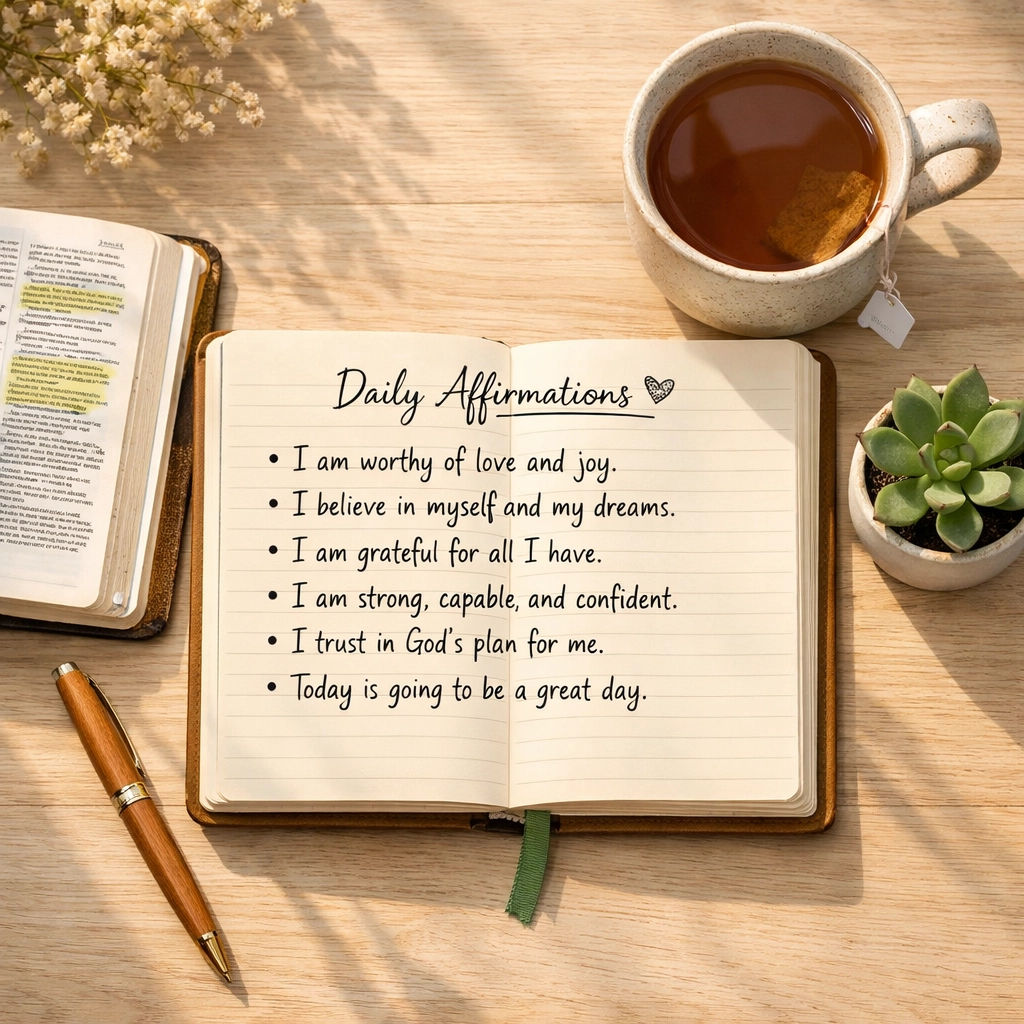
Minutes 3-4: Positive Affirmations Rooted in Truth
Speak out loud. Yes, out loud. Your brain processes spoken words differently than thoughts, and there's power in declaring truth over yourself before the lies start creaming.
Try these:
"I can handle today with God's help."
"I don't have to carry what I can't control."
"I am loved, I am equipped, and I am not alone."
"Peace is available to me, even in chaos."
These aren't empty mantras. They're reminders of what's true. When anxiety whispers you can't handle this, you're countering it with truth before it takes root.
Minutes 4-5: Intentional News Boundaries
Here's the decision that changes everything: don't check the news yet.
Instead, decide when you will check it. Maybe it's after breakfast. Maybe it's during your lunch break. Maybe it's at 6 PM when you're already grounded in your day.
The point isn't to avoid reality. The point is to not let reality ambush you before you've had a chance to center yourself. You're not burying your head in the sand: you're creating a protected window where you get to be a human being made in the image of God before you become a news consumer.
Set a specific time. Put a reminder in your phone if you need to. And give yourself permission to start your day on your terms, not the algorithm's.
The Invitation: Try It Tomorrow Morning
Look, this isn't about being perfect. It's about being intentional. You don't need to master all five steps on day one. Start with one minute of breathing. Add the grounding practice when you're ready. Build the habit slowly.
But here's what I know: when you give God the first five minutes instead of giving the news the first five seconds, your entire day shifts. You move from reactive to responsive. From anxious to anchored. From overwhelmed to covered.
The headlines will still be there. The chaos won't disappear. But you'll meet it from a different place: a place of peace that doesn't depend on the news cycle.
Try it tomorrow. Set your phone across the room tonight. When you wake up, breathe first. Ground yourself. Speak truth. Then decide when you'll engage with the world's noise.
You might be surprised how much steadier you feel when you start the day remembering whose you are before you remember what's broken.
Need prayers? Text us day or night at 1-901-213-7341.
Source: Research on breathwork, grounding techniques, and morning routines from clinical anxiety management studies

$50
Product Title
Product Details goes here with the simple product description and more information can be seen by clicking the see more button. Product Details goes here with the simple product description and more information can be seen by clicking the see more button

$50
Product Title
Product Details goes here with the simple product description and more information can be seen by clicking the see more button. Product Details goes here with the simple product description and more information can be seen by clicking the see more button.
$50
Product Title
Product Details goes here with the simple product description and more information can be seen by clicking the see more button. Product Details goes here with the simple product description and more information can be seen by clicking the see more button.
Comments