The 5 AM Christian News Commentary Guide: Stay Informed Without Losing Your Mind
- Dr. Layne McDonald
- Feb 17
- 5 min read

You know that feeling when you check your phone first thing in the morning and immediately regret it? Ten minutes later you're doom-scrolling through catastrophe after catastrophe, heart racing, anxiety spiking, already mentally exhausted before your first cup of coffee.
There's a better way.
Not ignorance. Not denial. Not the "just don't watch the news" approach that leaves you clueless when real conversations happen. Instead, imagine being genuinely informed about what's happening in the world while maintaining your emotional stability, spiritual clarity, and ability to love your neighbor well.
That's what the 5 AM Christian news commentary method is about: staying awake to reality without losing your peace, your kindness, or your mind.
Why 5 AM Changes Everything
The timing isn't arbitrary. At 5 AM, you have something precious: margin.
Your emotional resilience is at its highest after rest. Your mental filters aren't clogged with the day's accumulated noise. You have time to think, pray, and process instead of reacting. You're reading the news before the news reads you.

Most importantly, starting at 5 AM means you can anchor yourself in Scripture before the world gets a vote on your mood. Five minutes in the Bible before five minutes of headlines puts current events in eternal perspective. It reminds you that God is sovereign, Jesus is Lord, and you're called to be salt and light, not another voice amplifying chaos.
When you flip that order and check Twitter before opening your Bible, you're letting anxiety, outrage, and tribal instincts set the agenda for your day. You're consuming information through the lens of fear instead of faith.
The Framework: Facts, Lens, Response
Here's the practical method. When you encounter a news story, whether it's international conflict, political controversy, or cultural debate, run it through this three-step filter:
Step 1: Facts (What Actually Happened)
Strip away the commentary, the hot takes, the loaded adjectives. What are the verifiable facts? Who said what? What actions were taken? What's confirmed versus speculated?
Take a recent example: proposals around Gaza reconstruction involving international oversight, security frameworks, and multi-billion-dollar pledges. The facts are: multiple parties are discussing post-war rebuilding plans; various models are on the table; key details about governance and security remain unresolved.
What's not a fact: your social media feed's instant verdict about who's right, who's evil, or what it all means.
Step 2: Lens (What Does Scripture Say)
Once you know the facts, ask: what biblical principle applies here? Not "what verse can I weaponize to win an argument," but genuinely, what does God's Word say about this situation?
Romans 12:18 tells us: "If possible, so far as it depends on you, live peaceably with all." That doesn't mean pretending evil doesn't exist. It means we pursue peace actively, truthfully, and courageously. Any reconstruction plan should protect civilians, reject vengeance, and insist on accountability, because that's closer to God's heart than solutions built on propaganda or exploitation.
The biblical lens doesn't give you all the policy answers. It gives you the moral compass to evaluate proposals honestly.
Step 3: Response (How You Engage)
After facts and lens comes the question: now what? How do you respond from a place of faith rather than fear?
Sometimes the response is prayer. Sometimes it's a conversation with someone who disagrees. Sometimes it's supporting organizations doing practical work. Sometimes it's simply refusing to share inflammatory content that dehumanizes people made in God's image.
The response is never: panic, demonize, or assume the worst about everyone.

Four Types of News (and How to Handle Each)
Not all news requires the same emotional energy. Here's how to categorize what you're reading:
Breaking/Crisis News (wars, disasters, violence): Get the facts, pray immediately, limit consumption to verified sources, resist the urge to refresh every five minutes. Follow trusted outlets for updates, then step away.
Example: When faith leaders organize to push for diplomatic de-escalation with Iran, that's information worth knowing. It tells you people are working toward peace. You can pray for them. You don't need seventeen opinion pieces about it.
Cultural Commentary (speeches, debates, messages): Understand the context, recognize the stakes, resist tribal reflexes. Ask: what's the actual concern here, and is there legitimate truth in multiple perspectives?
Example: Senator Rubio's Munich speech about Western civilization and unity. Supporters say cultural confidence matters for strategic coherence. Critics worry about exclusionary framing. Both concerns can be real. Your job isn't to pick a team, it's to think clearly.
Faith/Church News (Pope Leo XIV's Lenten message on disarming language): Receive it with humility, test it against Scripture, apply what's true. Ephesians 4:29 says, "Let no corrupting talk come out of your mouths, but only such as is good for building up." That's not about silence, it's about removing malice while keeping truth.
Symbolic/Hopeful Stories (the monks' peace walk ending at Washington National Cathedral): Let these encourage you. Symbolic acts matter. They remind society that peace is possible, that prayer isn't nothing, that love can be louder than outrage.
The 30-Minute Rule
Here's the discipline: limit your morning news consumption to 30 minutes of focused, thoughtful reading.
Not two hours of scrolling. Not checking every notification. Not reading the same story on eight different sites. Thirty minutes. Get informed, gain perspective, pray, then get on with your day.
This isn't about ignorance. It's about stewardship. God gave you a mind, a heart, and a mission. Spending three hours a day marinating in outrage doesn't serve any of those things.
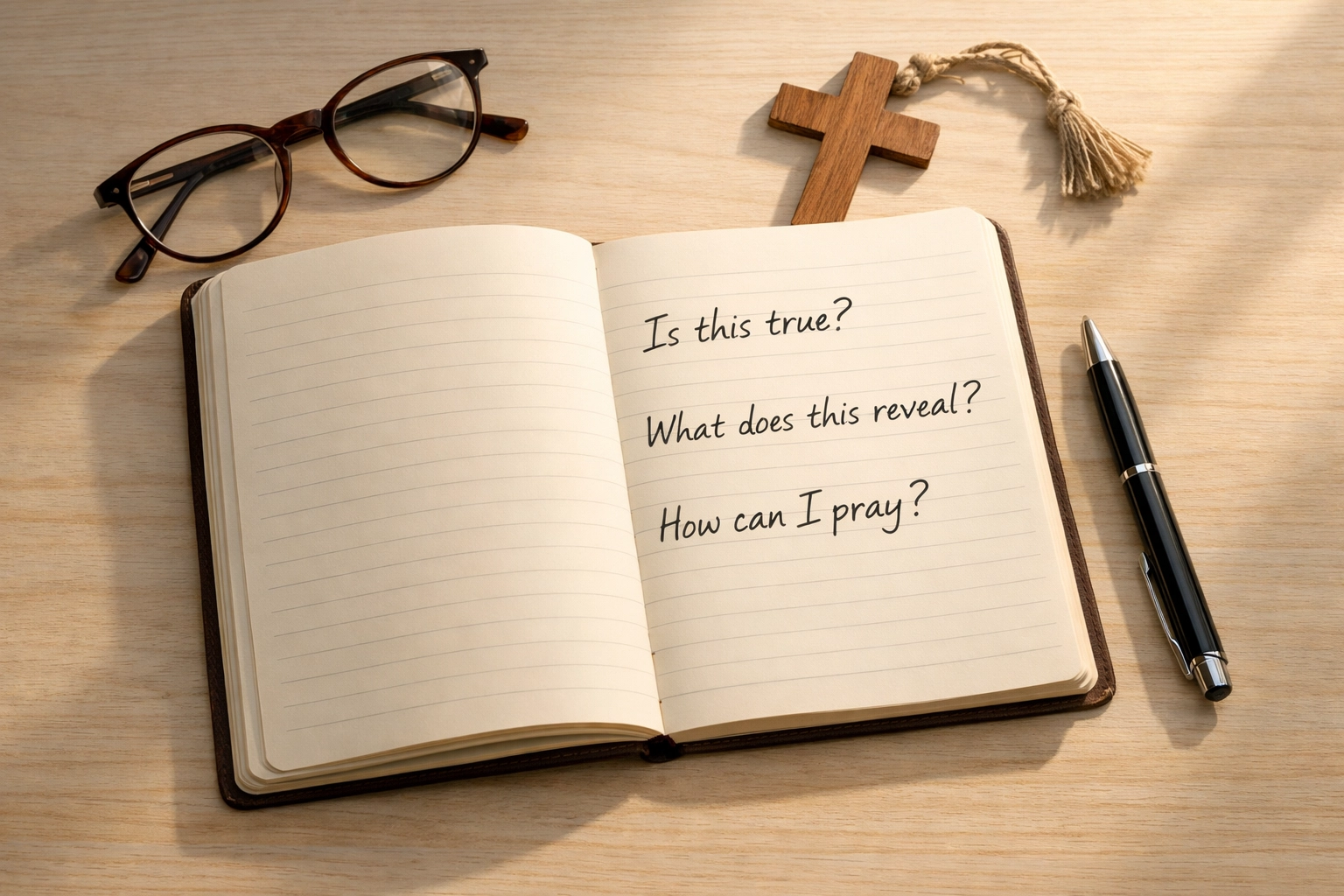
Questions That Save Your Sanity
When you read something that makes your blood pressure spike, pause and ask:
Is this true? (Not "does it confirm what I already think," but is it factually accurate?)
What does this reveal? (About systems, human nature, spiritual realities?)
Where is God in this? (Where do I see mercy, justice, courage, or opportunities for the Church?)
How can I pray about this? (For wisdom, for leaders, for civilians, for my own heart?)
What's mine to do? (Not what's everyone else's responsibility, what's mine?)
These questions shift you from reactive consumer to thoughtful steward.
What This Method Avoids
This approach is designed to protect you from three toxic traps:
Trap 1: Outrage Addiction. Some people become functionally addicted to being angry. They need the adrenaline spike of finding something to hate. A biblical news method starves that addiction.
Trap 2: Tribalism. When your primary identity is political rather than spiritual, every story becomes ammunition for your side. When your primary identity is "child of God," you can engage issues without needing to prove your team is always right.
Trap 3: Despair. Constant bad news without the anchor of Scripture breeds hopelessness. But Christians don't do despair. We acknowledge darkness while knowing the Light has already won.
The Calm You're Looking For
Here's what happens when you stick with this method for a month:
You stop feeling dictated by the news cycle. You respond to current events from a foundation of faith, hope, and love instead of fear and reactivity. You can have hard conversations without losing your cool. You stay informed without being consumed, aware without being overwhelmed, engaged without being controlled.
You become the kind of person who can say, "Yes, I know what's happening in the world, and I'm choosing to respond with wisdom, kindness, and courage instead of panic."
That's not naivety. That's maturity.
Your Next Step
Try it tomorrow. Set your alarm for 5 AM. Spend five minutes reading Scripture: a psalm, a gospel chapter, a passage you've been meaning to return to. Then spend 30 minutes getting informed. Use the Facts-Lens-Response framework. Pray. Then go live your day.
See if you notice a difference in your emotional state, your clarity, and your capacity to love people well.
Because staying informed and staying sane aren't opposites. They're supposed to work together. And when you let Scripture set the agenda instead of outrage, they do.
Need prayers? Text us day or night at 1-901-213-7341.
Follow for more Christ-centered clarity on today's biggest questions at LayeMcDonald.com.

$50
Product Title
Product Details goes here with the simple product description and more information can be seen by clicking the see more button. Product Details goes here with the simple product description and more information can be seen by clicking the see more button

$50
Product Title
Product Details goes here with the simple product description and more information can be seen by clicking the see more button. Product Details goes here with the simple product description and more information can be seen by clicking the see more button.
$50
Product Title
Product Details goes here with the simple product description and more information can be seen by clicking the see more button. Product Details goes here with the simple product description and more information can be seen by clicking the see more button.
Comments