Why Everyone Is Switching to 8 AM Breakfast Briefs (And You Should Too)
- Dr. Layne McDonald
- Feb 11
- 6 min read

Look, I get it. Your morning routine is already packed. You're juggling coffee, kids, emails that snuck in overnight, and trying to figure out if you need an umbrella. The last thing you need is another thing on your plate.
But here's what I've learned after years of watching people try to stay informed without losing their minds: what you consume first thing in the morning sets the tone for your entire day.
And right now, thousands of people are discovering that switching to an 8 AM news brief, specifically, one that's calm, truthful, and Christ-centered, is changing not just their mornings, but their whole relationship with current events.
The 8 AM Window: Why Timing Actually Matters
Recent research on breakfast timing reveals something fascinating. People who eat breakfast before 8:30 AM show lower blood sugar levels and better insulin resistance than those who eat later, regardless of what they eat. Scientists believe this happens because an early breakfast syncs with your body's circadian rhythm, essentially telling your internal clock, "Hey, the day has started."

The same principle applies to how we consume information. When you start your day with sensationalized headlines, panic-inducing push notifications, or algorithmic rage-bait, you're essentially programming your nervous system for chaos. Your body doesn't distinguish between a real threat and a scary headline: cortisol is cortisol.
But when you begin with calm, fact-based information that acknowledges hard realities without feeding fear, you're setting a completely different trajectory. You're telling your mind: "We can handle what's happening in the world. We don't have to panic. We can stay grounded."
What Makes a "Breakfast Brief" Different from Doomscrolling
Let's be honest about what most morning news consumption looks like. You unlock your phone. You see seventeen notifications. Three are about a political controversy, two are opinion pieces disguised as news, one is celebrity gossip, and the rest are trying to sell you something.
Within five minutes, you've absorbed:
Information you can't verify
Opinions presented as facts
Emotional manipulation designed to keep you scrolling
Zero actionable steps you can actually take
A true breakfast brief works differently. It gives you:
Verified facts. What actually happened, attributed to credible sources, without the editorial spin baked into the headline.
Context that matters. Not just what happened, but enough background to understand why it matters and what might happen next.
A lens for processing. Whether that's a biblical perspective, a historical parallel, or a values-based framework: something to help you think rather than just react.
An invitation to respond wisely. Prayer, practical action, or simply choosing not to carry the weight of things you can't control.

The "Pastor's Newsroom" Approach
Here's where The McReport's 8 AM briefs take a different path than traditional news. We call it the "pastor's newsroom" approach: truth without cruelty, conviction without contempt.
That means when we cover a breaking story: whether it's a humanitarian crisis, a policy debate, or a cultural shift: we don't sanitize the hard parts. We don't pretend everything is fine when it's not. But we also don't traffic in outrage, tribal point-scoring, or the kind of language that treats people as enemies rather than image-bearers of God.
We keep the Facts section cold and neutral. We save the emotional language for where it belongs: calls to love, kindness, mercy, hope, grace, forgiveness, and peace.
Because here's what I've learned: you can tell the truth and still leave people with hope. You can acknowledge brokenness and still point toward redemption. You can be informed without being overwhelmed.
What Consistency Does for Your Soul (Not Just Your Schedule)
Remember that research about breakfast timing? One of the most compelling findings wasn't just about eating at 8 AM: it was about eating at the same time every day.
Older adults who maintained consistent breakfast times reported:
Better sleep quality
More steady energy throughout the day
Improved mood
Less anxiety
Inconsistent timing, on the other hand, correlated with restless nights, energy crashes, and mood dips.
The same pattern shows up with news consumption. When you have a consistent, bounded time to catch up on what matters: say, fifteen minutes at 8 AM: you're not constantly checking your phone, wondering what you're missing, or spiraling into a three-hour scroll session that leaves you exhausted and cynical.
You get your information. You process it with a clear framework. You pray or take action where it's appropriate. And then you move on with your day.
That rhythm protects your peace without keeping you in the dark.
The Structure That Keeps You Steady
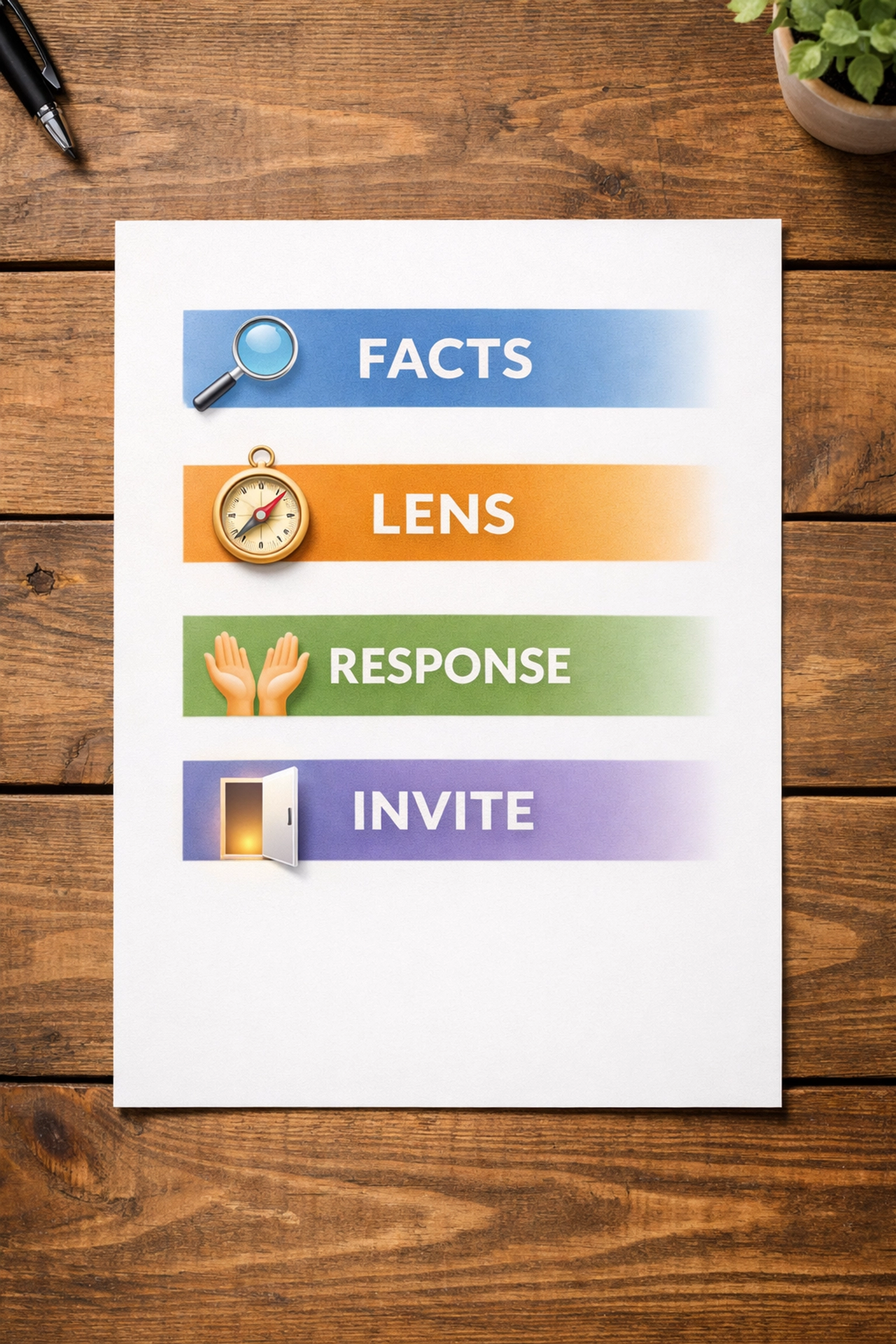
Every McReport 8 AM brief follows the same framework:
Facts: What happened, according to credible sources, with proper attribution. No loaded language, no manipulation: just the information you need.
Lens: A biblical or values-based perspective to help you process what you just read. This isn't about forcing a religious spin on every story: it's about offering a grounding point when the world feels unmoored.
Response: Practical next steps. Sometimes that's prayer. Sometimes it's a specific action. Sometimes it's simply choosing not to carry the weight of something outside your control.
Invite: A contextual next step that matches the tone of the story. For breaking news, it might be "Follow for calm updates." For a hopeful story, it might be "Share this to encourage someone today." For cultural analysis, it might be "Explore more Christ-centered clarity at LayneMcDonald.com."
This structure does something powerful: it trains your brain to move from reaction to response. You're not just consuming information: you're integrating it in a way that aligns with your values and your faith.

Why People Are Making the Switch
I've talked to hundreds of readers who've switched to the 8 AM brief model, and the same themes come up over and over:
"I don't feel manipulated anymore." They appreciate knowing the difference between reporting and commentary, and they value sources being clearly cited.
"I can actually think instead of just reacting." The biblical lens gives them a framework for processing hard news without spiraling into despair or rage.
"I feel less anxious." Knowing they have a set time to catch up on what matters: and that it won't consume their whole morning: has dramatically reduced their stress.
"I don't have to choose between staying informed and protecting my peace." This might be the biggest one. For years, people felt like the only options were doomscrolling or sticking their head in the sand. A well-crafted brief offers a third way.
The Longevity Angle You Didn't Expect
Here's one more research finding I can't stop thinking about: a decades-long study found that people who ate breakfast earlier had a 10-year survival rate of 89.5%, compared to 86.7% for late eaters. Each additional hour of delay was linked to higher mortality risk.
Now, I'm not saying that reading your news at 8 AM will literally extend your life (though the stress reduction might help). But there is something to the idea that how we start our day: what rhythms we build, what information we consume, what posture we take toward the world: compounds over time.
If you spend the next decade starting every morning in a state of low-grade panic, that's going to shape your body, your mind, and your spirit in measurable ways.
If you spend the next decade starting every morning grounded in truth, hope, and a framework bigger than the news cycle, that's going to shape you too.

How to Make the Switch
If you're ready to try the 8 AM brief approach, here's how to start:
Set a boundary. Decide that you won't check news: any news: until 8 AM. Let your nervous system wake up in peace.
Pick one trusted source. Don't try to cross-reference five different outlets before breakfast. Choose a brief that aligns with your values and gives you verified, well-sourced information.
Follow the structure. Read the facts. Sit with the lens. Take the response step: whether that's prayer, action, or release. Then close it and move on.
Protect the time. Fifteen minutes. That's it. If a story requires deeper research, bookmark it for later. Don't let your morning brief turn into a two-hour scroll.
Notice the difference. After a week, check in with yourself. How's your stress level? Your focus? Your sense of hope? Most people notice a shift within days.
The Invitation
The world isn't going to stop being complicated. The news cycle isn't going to slow down. But you can change your relationship with it.
You can choose information over manipulation. Clarity over chaos. Hope grounded in truth instead of denial or despair.
And you can start tomorrow at 8 AM.
Follow at LayneMcDonald.com for calm, Christ-centered news briefs that help you stay informed without losing your peace.
Comments