
Good News: Students Build 'World's First' Solar-Powered Ambulance : Field-Testing in Kenya as a Mobile Clinic
- Dr. Layne McDonald
- 17 hours ago
- 6 min read

Immediate Answer
Twenty-three students at Eindhoven University of Technology developed Stella Juva, reported as the world’s first solar-powered ambulance. The vehicle is now being field-tested in Kenya as a solar-powered mobile clinic, according to university, project, and partner reports. It remains a research prototype under evaluation: not a finished commercial product with independently verified results.
By Dr. Layne McDonald August 24, 2026 | 7:00 a.m. wave
What Happened
A student engineering team from the Netherlands has brought a new kind of healthcare vehicle to Kenya for real-world testing.
The vehicle, called Stella Juva, was developed by Solar Team Eindhoven, a group of 23 students from Eindhoven University of Technology. Project and partner reports describe it as the “world’s first” ambulance designed to operate entirely on solar power.
That designation is a claim made in project reporting and has not been independently verified by The McReport. The more important fact at this stage is that Stella Juva is now in a field-testing phase, where its design is being evaluated in actual conditions.
The Kenya launch was hosted by Amref International University. According to Amref’s account, the vehicle is traveling through Nakuru, Narok, and Kajiado counties. The testing includes different terrains and simulated mobile-clinic operations.
Unlike a conventional ambulance whose primary role is to transport a patient to a hospital, Stella Juva is designed as a mobile healthcare platform. The goal is to bring medical services closer to people living far from hospitals, electrical grids, fuel supplies, or reliable roads.
The student team has presented the vehicle as capable of generating power for both transportation and medical equipment. Amref reports that the vehicle includes space for medical supplies, a cooling box, foldable seats, and electricity for healthcare activities.
The team has also reported a possible range of up to 750 kilometers, combining battery power with additional energy generated by its solar panels. The panels reportedly cover approximately six square meters of the vehicle. These figures are project specifications being tested in practice, not a guarantee of performance in every environment.
The Kenya trial is intended to examine how the vehicle performs on paved and unpaved roads, how well it handles off-road conditions, and whether it can reliably power equipment during healthcare visits.
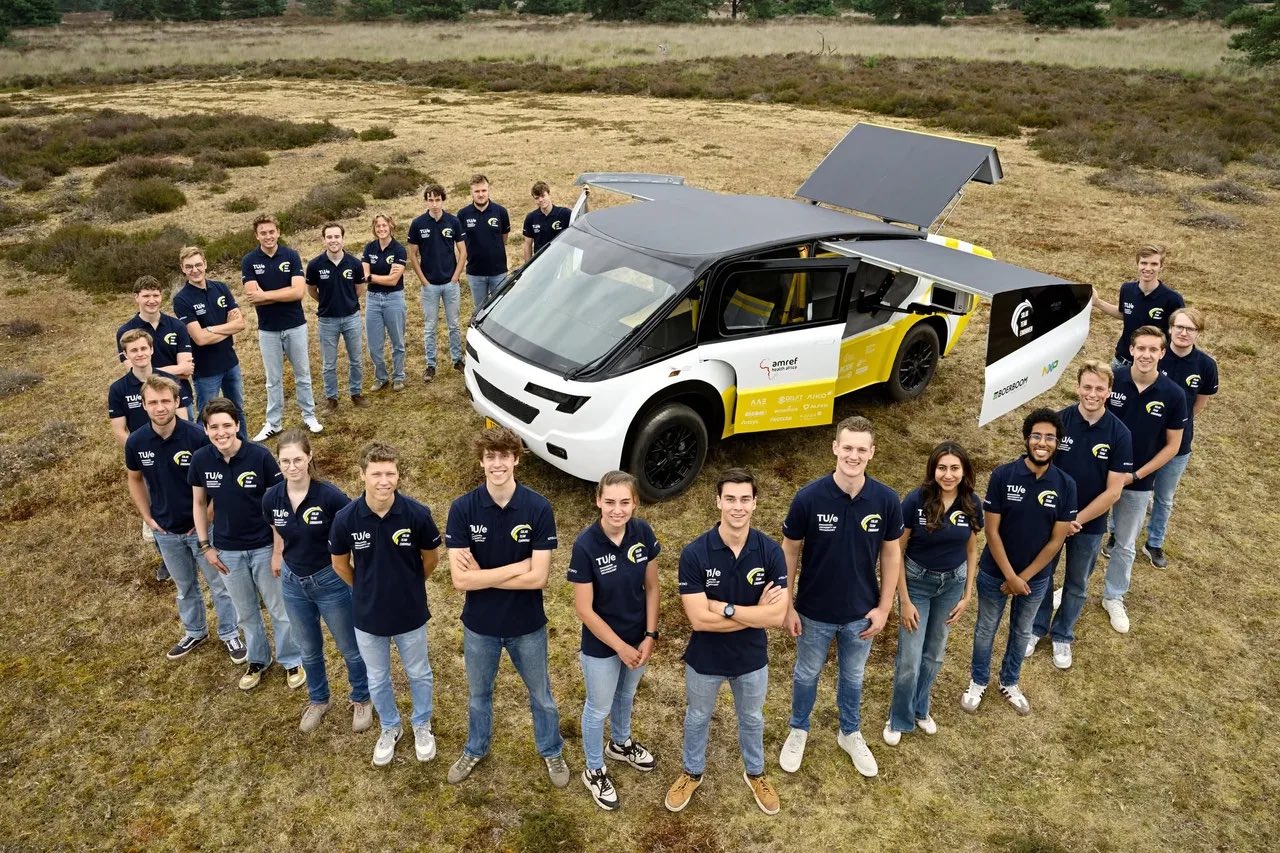
Photo courtesy of Amref International University. The image shows the student team and vehicle connected to the project; it is not presented as an independent verification of the “world’s first” designation.
Both Sides
Supporters see Stella Juva as a promising meeting point between clean energy, engineering, and public health.
For communities with limited access to electricity and transportation, a mobile clinic could help bring screenings, preventive care, vaccinations, and basic medical services closer to home. A vehicle that can produce some of its own energy may also reduce dependence on fuel and charging infrastructure.
Amref officials and Kenyan public-health representatives have emphasized the continuing challenge of reaching people in remote areas. Long distances, difficult roads, and limited healthcare infrastructure can delay care, particularly for women, children, and families living far from established facilities.
The project also represents an international partnership. Dutch students, Kenyan health professionals, university leaders, and public officials are examining whether a university-built vehicle can fit the needs of communities on the ground.
There are also reasonable questions.
A prototype must prove that it can withstand heat, dust, rough roads, weather changes, and the demands of repeated medical use. Local technicians must be able to maintain it. Health workers must find it practical. Replacement parts, training, safety standards, battery life, and total cost will all matter.
There is also a difference between a vehicle that can travel long distances under favorable conditions and one that can provide dependable healthcare service over time. Solar energy may support mobility and equipment, but real-world effectiveness will depend on the entire healthcare system surrounding the vehicle.
Measured hope is the right response. The concept is encouraging. The testing is necessary. The results should be allowed to speak for themselves.
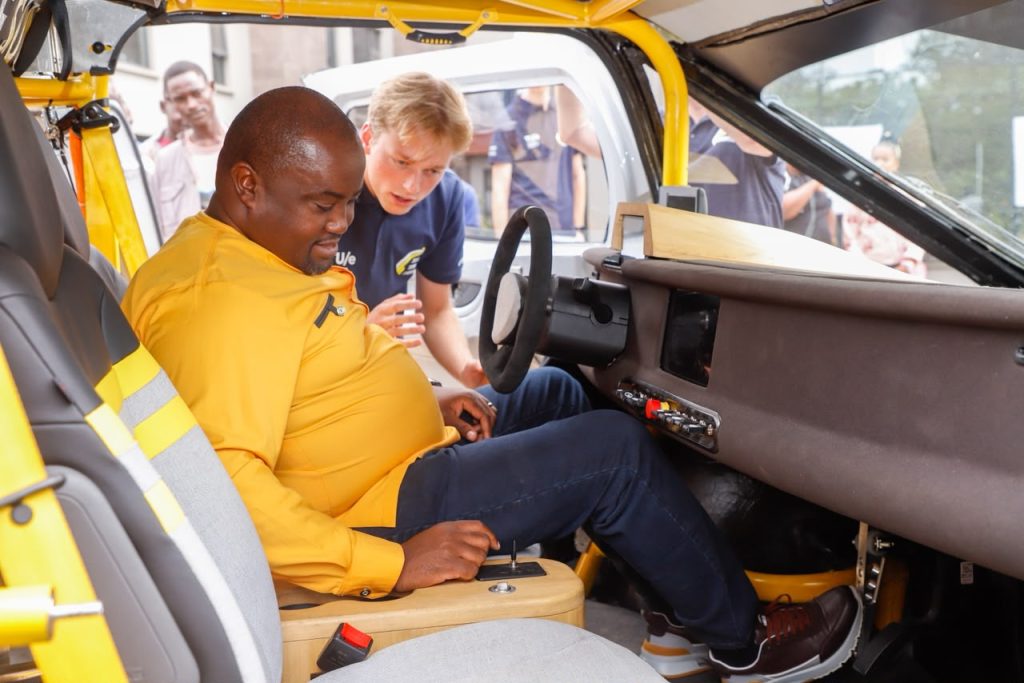
Photo courtesy of Amref International University. This image illustrates the vehicle’s interior and design; it does not establish final medical or operational certification.
Why It Matters
The story is about more than a vehicle.
It raises a practical question: What happens when technology is designed not merely to move faster, but to reach people who are often overlooked?
Healthcare access is shaped by roads, distance, electricity, fuel, staffing, and cost. A mobile clinic cannot solve every problem, but it can challenge the assumption that care must always wait for a large building, a stable grid, or a nearby hospital.
The project also shows the value of students working on problems beyond the classroom. Engineering education becomes especially meaningful when knowledge is directed toward human needs. The vehicle may still require substantial testing and improvement, but its purpose is clear: use creativity to bring care closer to vulnerable communities.
That purpose deserves attention without exaggeration.
The world has seen many announcements of breakthrough technology. Some mature into useful tools. Others remain demonstrations. Stella Juva is still in the stage where careful observation, local partnership, and honest reporting matter more than celebration alone.
Its success should not be measured only by speed or range. It should be measured by whether health workers can use it, whether communities trust it, whether it can be maintained, and whether it helps people receive care more consistently.
Top Three Takeaways
1. Innovation matters most when it serves people
Stella Juva is being tested as a tool for healthcare access, not simply as an engineering achievement. The strongest innovations are those that answer real needs and honor the dignity of the people they are meant to serve.
2. Field testing is where promises meet reality
The “world’s first” language remains a reported project claim. The vehicle’s performance, durability, maintenance needs, and usefulness in remote Kenyan communities still require evaluation. Responsible excitement leaves room for evidence.
3. Hope can be practical
This story offers a constructive example of students, universities, health organizations, and public officials working across borders. It reminds us that hope is not denial of difficulty. Hope can mean building, testing, repairing, learning, and trying again for the good of others.
Eternal Center
Psalm 104:24 says:
“How many are your works, Lord! In wisdom you made them all; the earth is full of your creatures.”
That verse gives us a healthy way to think about technology.
Human creativity is not a replacement for God, and innovation is not automatically virtuous simply because it is new. But when knowledge is directed toward mercy, stewardship, and service, it can reflect something good about the wisdom woven into creation.
A solar-powered mobile clinic does not eliminate the need for doctors, nurses, public health workers, local leadership, or prayer. It does not turn a prototype into a solution overnight. But it may become one useful instrument in the larger work of caring for neighbors.
The Christian response is neither cynicism nor careless applause. It is gratitude joined with discernment.
We can thank God for the students who imagined a new possibility. We can honor the Kenyan communities whose needs are helping shape the test. We can pray for the health workers who will use the vehicle. And we can ask whether the project continues to place people: not publicity: at the center.
What to Watch Next
The Kenya field tests are expected to provide the clearest evidence yet about how Stella Juva performs outside the university environment.
Watch for reports from the planned testing areas in Nakuru, Narok, and Kajiado. Important questions include:
How does the vehicle handle unpaved and difficult terrain?
Can it provide dependable power for medical equipment?
How does solar generation perform under changing weather and operating conditions?
What maintenance and training are required?
Do local healthcare workers find the mobile-clinic design useful?
What would be required for the concept to move beyond a university prototype?
Those answers will help distinguish a compelling demonstration from a durable healthcare solution.
Practical Takeaway
Celebrate innovation that serves others, support responsible technology for community health, and consider how simple ideas can meet real needs near you. A new solution does not have to be perfect before it deserves thoughtful encouragement: but it should always be tested with humility, honesty, and care for the people affected.
For hope-filled, Christ-centered reporting, visit www.laynemcdonald.com.
Sources
Source: Attributed university and project reporting, August 2026.
Comments